


E-Commerce Strategies
If you're an Amazon seller shipping products to the EU, the 2026 EU Customs Code reform brings big changes. Sellers and platforms are now officially labeled as "importers of record", meaning you’re legally responsible for customs, duties, and product compliance. Amazon won’t act as your Importer of Record (IOR), so the burden falls on you.
Key points:
Customs Responsibilities: Accurate HS codes, declared values, and origin details are required. Errors can lead to 48-hour holds or penalties.
Product Compliance: Meet EU standards like CE marking, REACH, and GPSR.
VAT and IOR Alignment: Your IOR entity must match your Amazon VAT registration.
Record-Keeping: Retain customs records for at least 4 years.
For non-EU sellers, options include setting up an EU-based entity (6–12 months) or using a Seller of Record (SoR) structure (2–3 weeks). Alternatively, partnering with an EU distributor can simplify compliance but reduces profit margins by 30–50%.
Quick Comparison:
Factor | Amazon Seller as Importer | EU Distributor |
|---|---|---|
Margin Retention | Full margin | 30–50% margin loss |
Compliance Responsibility | Seller handles compliance | Distributor manages it |
Setup Time | 2–3 weeks (SoR) or 6–12 months | Immediate market entry |
Legal Liability | Seller assumes liability | Distributor takes on risk |
Customer Relationship | Direct | Managed by distributor |
The choice depends on your priorities: control and profit vs. simplicity and speed. Ensure compliance to avoid delays, fines, or listing suppression.
Amazon Product Compliance Requirements in the EU

1. Amazon Sellers Acting as Importers
Under the 2026 EU Customs Code reform, Amazon sellers shipping goods from outside the EU to customers within the EU are now officially classified as "deemed importers." This designation comes with enforceable obligations from customs authorities.
As the importer of record, you’re responsible for submitting precise customs data. This includes correct HS tariff codes, accurate declared values, and the country of origin for each shipment. You’re also required to pay import duties and VAT. Mistakes in these areas can lead to serious consequences, such as a 48-hour customs hold - with your inventory detained in a bonded warehouse at your expense. These stringent customs rules highlight the operational and compliance hurdles Amazon sellers must navigate.
Product safety is another critical responsibility that often surprises sellers. All goods must meet EU standards, such as CE marking, REACH compliance, and the General Product Safety Regulation (GPSR). A recent EU-wide inspection revealed that over 50% of 20,000 e-commerce products tested failed to meet safety requirements. Failure to comply can result in costly delays and penalties.
One operational challenge specific to Amazon sellers is ensuring that the legal entity listed as your Importer of Record (IOR) matches the VAT registration on your Amazon Europe seller account. For non-EU sellers, this means either setting up an EU-based entity or appointing a representative with Authorised Economic Operator (AEO) status.
"The IOR is who customs authorities hold accountable if the declaration is incorrect, duties are underpaid, or goods are non-compliant. The rule is simple: the IOR must be an EU-established entity with an EORI number. No exceptions." - Harsh Vaidya, Author, EuroSOR
Lastly, record-keeping is non-negotiable. Importers are required to retain customs records for at least four years to prepare for potential audits. Even if a third party handles your filings, the legal responsibility remains yours unless the representative has explicitly agreed to take on that liability in writing.
2. Standard EU Importers
A standard EU importer refers to a business legally based in the EU that holds a valid Economic Operators Registration and Identification (EORI) number, which is mandatory for all customs-related activities. Traditional importers have been operating under this framework for years, unlike Amazon sellers in the European market, who are now classified as "deemed importers" and are just beginning to navigate these requirements. These long-established processes highlight the significant differences between traditional importers and the newly imposed responsibilities on Amazon sellers.
Daily responsibilities for standard importers include filing accurate declarations and ensuring that all products meet compliance standards. For instance, before goods even reach the EU, importers must submit an Entry Summary Declaration (ENS). Once the goods arrive, they need to file a formal import declaration using the H1 electronic format. This document covers critical details like HS tariff codes, declared value, country of origin, and any applicable duties. Mistakes in these documents can lead to fines and delays, which together average around $10,700.
In addition to customs declarations, importers must ensure that their products adhere to EU technical standards, such as CE marking, REACH, and RoHS. They are also responsible for complying with Extended Producer Responsibility (EPR) regulations, which can cost mid-sized brands (with sales between $2M and $5M) anywhere from $3,200 to $16,100 annually.
The 2026 reforms brought in a "Trust and Check" system, offering benefits like reduced inspections and more flexible payment terms for compliant importers. However, achieving this status requires a high level of transparency and seamless integration of data systems - a significant upfront commitment but one that provides operational advantages.
"With online platforms and sellers as the official importers, EU consumers can be reassured that all taxes and duties have been paid and that their purchases are safe." - European Commission
Non-compliance carries steep penalties. Repeated violations can result in fines ranging from 1% to 6% of the total value of imported goods over the past 12 months. Additionally, goods held up at customs must either clear inspection or be re-exported within 90 days. These structured compliance measures have been a cornerstone of operations for traditional EU importers, setting them apart from Amazon sellers, who are now grappling with these stringent obligations for the first time.
Pros and Cons
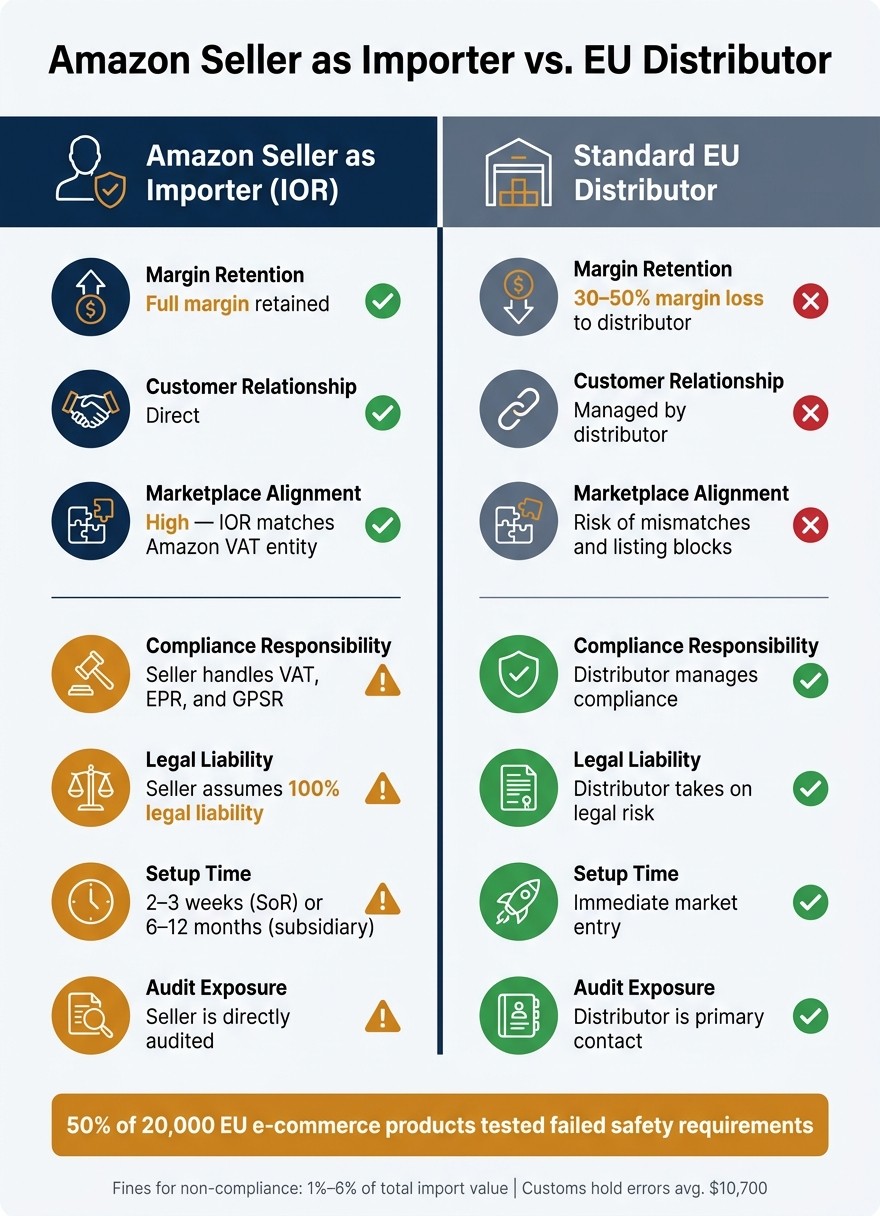
Amazon Seller as Importer vs. EU Distributor: Key Differences
When weighing the options between becoming your own Importer of Record (IOR) and using a traditional EU distributor, it's all about balancing control with complexity.
Taking on the IOR role gives Amazon sellers full control over pricing, profit margins, and direct customer relationships. On the flip side, relying on a traditional EU distributor often means sacrificing 30% to 50% of your margin in exchange for having someone else handle compliance and logistics.
Beyond margins, there's a marketplace reality to factor in. Using a third-party distributor or freight forwarder can sometimes lead to mismatches between the IOR entity and marketplace accounts. This mismatch can trigger account reviews and even suppress listings. Compliance specialist Harsh Vaidya warns:
"The IOR entity must match the entity on Amazon, Zalando, and other marketplace accounts. Mismatches trigger account reviews and listing suppression."
However, taking on the IOR role isn't without risks. Sellers assume 100% of the legal liability for customs declarations, HS tariff codes, and product safety compliance. Mistakes in documentation can result in customs holds that typically last about 48 hours - and fixing errors after goods arrive is far pricier than addressing them beforehand. For non-EU sellers, there's an added hurdle: they can't hold an EORI number without an EU-based entity. This means they must either set up a local subsidiary (which can take 6 to 12 months) or work through a Seller of Record (SoR) structure, which is faster at 2 to 3 weeks. In contrast, traditional distributors offer a quicker path to market entry but at the cost of control and flexibility.
Here’s a side-by-side comparison of the two models:
Factor | Amazon Seller as Importer | Standard EU Distributor |
|---|---|---|
Margin Retention | Full margin retained | 30–50% margin loss to distributor |
Customer Relationship | Direct | Managed by distributor |
Marketplace Alignment | High - IOR matches Amazon VAT entity | Risk of mismatches and listing blocks |
Compliance Responsibility | Seller handles VAT, EPR, and GPSR | Distributor manages compliance |
Legal Liability | Seller assumes full liability | Distributor takes on legal risk |
Setup Time | 2–3 weeks (SoR) or 6–12 months (subsidiary) | Immediate market entry |
Audit Exposure | Seller is directly audited | Distributor is primary contact |
The decision ultimately comes down to priorities. Sellers who value brand control, direct access to customer data, and pricing flexibility may find the IOR model worth the added complexity. On the other hand, those seeking a faster and more straightforward way into EU markets might prefer distributors - just be prepared for the tradeoffs in margin and marketplace alignment.
Conclusion
Selling in the EU comes with its fair share of legal hurdles. One major challenge is that Amazon does not act as the Importer of Record (IOR) for FBA inventory. This means sellers need to establish a compliant EU-based structure before their first shipment even leaves. Essentially, the responsibility for compliance shifts squarely onto the seller's shoulders.
Navigating these responsibilities goes beyond just clearing customs. Sellers must ensure their IOR entity aligns with VAT registration, manage Extended Producer Responsibility (EPR) where applicable, and confirm that all products meet General Product Safety Regulation (GPSR) standards. Failure to comply can lead to listing suppression, customs delays, or even fines as steep as $10,000.
Still, there’s a silver lining for sellers who act strategically. The tentative EU-US trade agreement, approved on May 20, 2026, eliminates tariffs on industrial goods, offering a chance to improve margins for U.S.-based sellers with the right setup. However, the removal of the €150 de minimis exemption starting July 1, 2026, means duties will apply to all imports, no matter the value.
"The choice is not between compliance and growth. It's between building the structure yourself (which takes time, multiple providers, and ongoing coordination)... or using a Seller of Record structure that takes accountability for the operating layer end to end." - Harsh Vaidya, Author, EuroSOR
To stay ahead, sellers should focus on these key steps:
Confirm your freight forwarder’s role: Ensure they are acting as your agent and not taking on IOR duties.
Match your IOR and VAT entities: Verify that the IOR entity aligns exactly with the VAT entity registered on your Amazon seller account.
Re-classify your product catalog: Use accurate HS codes to prepare for upcoming customs data requirements.
Meeting these compliance standards is what separates successful sellers from those stuck at customs. If this process feels overwhelming, teaming up with a full-service Amazon consulting agency like eStore Factory can help. They can ensure your account structure, product listings, and compliance documents are in order before any issues arise.
FAQs
What do I need to do to get an EU EORI number as a non-EU Amazon seller?
As a non-EU Amazon seller, you typically can't serve as your own Importer of Record because an EU-based entity is required to have an EORI number. To manage customs declarations, you'll need to appoint an indirect representative, such as a customs broker or a third-party service. You can apply for an EORI number through the customs authority in the EU country where your initial customs operation will take place.
How can I avoid customs holds caused by HS code or declared value mistakes?
To avoid customs holds, focus on providing accurate HS codes and declared values. Use a reliable database of HS codes that aligns with the EU Combined Nomenclature, factoring in the product’s material, function, and intended use. Always declare the customs value on a CIF basis, which includes freight, royalties, and fees. Ensure invoices are standardized, clearly linking SKUs to their corresponding HS codes. Partnering with a licensed customs broker who has an active EORI number can also streamline the process and help prevent delays.
Which option is best for me: setting up an EU entity, using a Seller of Record, or using a distributor?
The right decision hinges on your growth objectives, sales volume, and comfort with risk. Establishing an EU entity offers complete control, but it can take 6–12 months to set up and demands a considerable upfront investment. On the other hand, working with a distributor streamlines operations yet typically eats into 30%–50% of your margins and restricts direct access to customers.
For brands looking to scale, a Seller of Record service is often a solid option. It centralizes compliance responsibilities, including IOR, VAT, and EPR, across all 27 EU countries.






