


E-Commerce Strategies
Selling on Amazon in the Middle East requires proper licensing and compliance. Starting January 1, 2026, stricter rules in the UAE and Saudi Arabia will impact sellers. Here's what you need to know:
UAE: Sellers need a trade license (e.g., DED eTrader, Free Zone, or Mainland license). Costs range from ~$275 to $6,800 annually. VAT registration is mandatory for non-residents or if sales exceed ~$102,000.
Saudi Arabia: A Commercial Registration (CR) is required. Foreign businesses need a MISA license. Setup costs range from ~$6,700 to $16,000. VAT is 15%, and registration is mandatory for all sellers.
Both regions require product approvals for certain categories (e.g., food, cosmetics, electronics). Incorrect documentation or mismatched business names can lead to delays, account suspension, or fines. Ensure compliance with activity codes, consult with Amazon experts VAT registration, and product certifications to avoid disruptions.
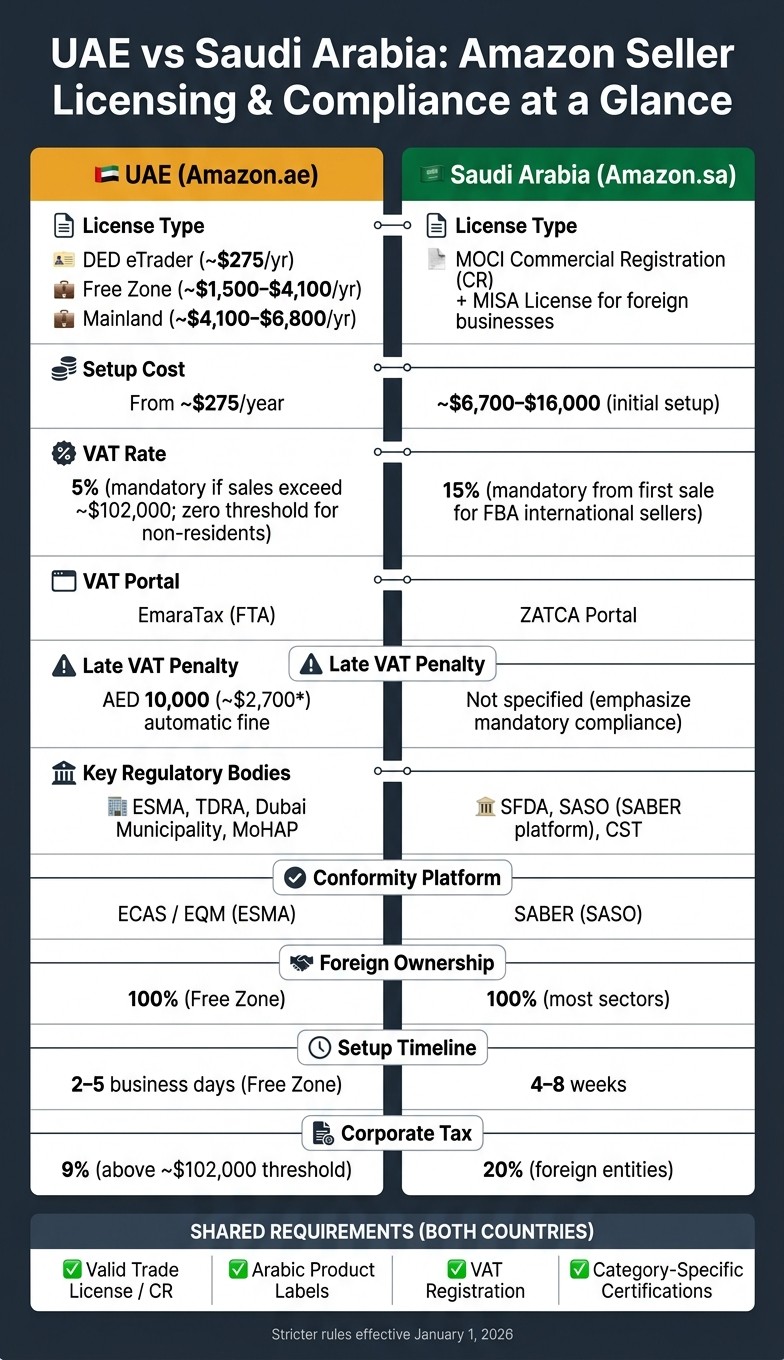
UAE vs Saudi Arabia: Amazon Seller Licensing & Compliance Guide
How to Register on Amazon as a Seller in UAE and Saudi Arabia | Full Guide for 2025
Licensing Basics for Amazon Sellers in the Middle East
To establish your Amazon business in the Middle East, you need to operate as a licensed business entity. The type of license required depends on your location, the products you sell, and your business structure. Here's a breakdown of the essentials.
Trade Licenses and Commercial Registrations Explained
In the UAE, sellers can choose from three main license types:
DED eTrader License: Costs approximately AED 1,070 (~$275) annually and is available exclusively to UAE residents and nationals.
Free Zone E-Commerce Licenses: These cost between AED 5,500 and AED 15,000 (~$1,500 to $4,100) per year. They are ideal for non-residents and foreign nationals, offering 100% foreign ownership and eligibility for investor visas.
Mainland Commercial License: Ranging from AED 15,000 to AED 25,000 (~$4,100 to $6,800) annually, this option suits sellers who need a physical warehouse or storefront within the UAE mainland.
In Saudi Arabia, sellers need a MOCI Commercial Registration (CR) issued by the Ministry of Commerce. Foreign-owned businesses must also secure a MISA Investment License to operate legally. Initial setup costs in Saudi Arabia, including office space and registration fees, typically range from SAR 25,000 to SAR 60,000 (~$6,700 to $16,000).
It's crucial that your trade license's legal business name matches the name entered in your Amazon Seller Central account. Additionally, using proper activity codes and securing product-specific approvals will help ensure compliance.
E-Commerce Activity Codes and Product Approvals
A trade license must include the correct activity codes to cover online sales. In the UAE, the relevant codes are 6312009 (Online Seller) and 4791.02 (Retail Sale via Internet). In Saudi Arabia, MOCI activity codes determine which customs HS codes you can use for importing goods.
Incorrect activity codes can lead to Amazon account rejections or banking issues. Furthermore, certain product categories on Amazon are "gated", meaning they require additional approvals before listing. For example, food, cosmetics, electronics, and pharmaceuticals need documentation such as safety certifications and regulatory approvals. Below is a quick reference table:
Product Category | Approval Body (Saudi Arabia) | Approval Body (UAE) |
|---|---|---|
Food & Beverages | SFDA | Dubai Municipality / MOIAT |
Electronics | CITC / SASO | TDRA / ESMA |
Cosmetics | SFDA | Dubai Municipality (Montaji) |
Pharmaceuticals | SFDA / Ministry of Health | Ministry of Health |
VAT Registration Requirements
Tax compliance is another critical aspect for Amazon sellers. Both the UAE and Saudi Arabia require VAT registration. Here’s what you need to know:
In the UAE, VAT registration becomes mandatory if your annual taxable supplies exceed AED 375,000 (~$102,000). For non-resident businesses, the threshold is zero - you must register from your first sale.
The VAT rate is 5% in the UAE, while Saudi Arabia charges 15%.
On Amazon UAE, sellers are responsible for charging, collecting, and remitting VAT to the Federal Tax Authority (FTA). Registration is done through the EmaraTax portal in the UAE and ZATCA in Saudi Arabia. Missing the registration deadline in the UAE results in an automatic AED 10,000 (~$2,700) penalty.
If your taxable supplies exceed AED 187,500 (~$51,000), voluntary VAT registration is an option. This allows you to reclaim VAT on expenses like Amazon fees, advertising, and imported inventory.
Licensing Requirements for Amazon UAE
Legal Setup for Amazon.ae
If you're planning to sell on Amazon.ae with a Professional Seller account, you'll need a valid UAE trade license. This license must list an e-commerce or trading activity, and the business name must match exactly between your trade license and your Seller Central account.
When selecting a license, it's important to consider both compliance and your operational needs. For instance, the DED eTrader License (approximately $300 per year for UAE and GCC residents) is a budget-friendly option, but it has limitations. It doesn't allow for corporate banking or importing goods under a customs code. If you need these capabilities, a Free Zone or Mainland license is a better choice, as they offer more flexibility for banking and importing inventory. Picking the right license can simplify product approvals and streamline payment processes.
Once your legal setup is in place, you'll need to focus on ensuring your products meet Amazon.ae's category-specific listing requirements.
Product Approvals and Gated Categories on Amazon.ae
Not all products can be listed on Amazon.ae without prior approval. Many categories are gated, meaning you'll need Amazon's permission before your product can go live. To check if approval is required, use the "Add Products" tool in Seller Central.
Approval requirements can vary depending on the category, sub-category, brand, or even the individual ASIN. Common documentation includes invoices dated within the last 180 days, clear photos of the product packaging from all angles, brand authorization letters, and any necessary safety certifications. Amazon typically reviews these submissions within 2 to 7 business days.
Additionally, certain products require registration with UAE government authorities before they can be sold. For example, food, cosmetics, and health supplements often need approval from organizations like Dubai Municipality, MoHAP, or ESMA.
"Approval is required to ensure products sold in our store are safe, authentic, and meet regulations." - Amazon Seller Central
A helpful tip: Make sure your product listing on Amazon exactly matches the details in your government-approved product file. Any mismatches in claims, ingredients, or warnings can lead to your listing being suppressed.
Category Type | Examples | Approval Requirement |
|---|---|---|
Unrestricted | Home & Garden, Toys & Games, Office Products | Generally open to all sellers |
Restricted (Gated) | Beauty, Grocery & Gourmet Food, Health & Personal Care | Requires Amazon approval and supporting documentation |
Highly Regulated | Medical Devices, Dietary Supplements, Disinfectants | Requires specific UAE government certifications (MoHAP/ESMA) |
Once your products are approved, you’ll need to set up a compliant banking arrangement to ensure smooth payouts.
Banking and Payment Setup in the UAE
To receive payments from Amazon.ae, you must have a bank account on file. For Professional Sellers, a UAE corporate bank account is recommended to avoid any issues. Amazon processes payouts every 14 days, deducting referral fees, fulfillment costs, and advertising expenses.
It's crucial to ensure that the names on your bank account, trade license, and Seller Central account match perfectly. Even small discrepancies can cause delays during verification. As part of this process, you’ll need to submit a bank statement dated within the last 90 days. Keep in mind that eTrader licenses typically don’t support corporate banking, so if you require a corporate account, a Free Zone or Mainland license is the way to go.
Licensing Requirements for Amazon Saudi Arabia
Legal Entity and Documentation for Amazon.sa
To sell on Amazon.sa, you need a valid Commercial Registration (CR). Saudi nationals have two options: they can either obtain a standard CR for a sole proprietorship or secure a Freelancing Practitioner Certificate, which is only available to Saudi citizens. Foreign investors, however, must first secure a license from the Ministry of Investment (MISA) before applying for a CR.
Most business entities, including individual enterprises and LLCs, can be registered online via the Saudi Business Center (business.sa) or the Ministry of Commerce. Additionally, there’s no longer a requirement to deposit capital upfront when issuing a CR for these entities.
Here’s what you’ll need:
CR
KSA National ID or Iqama
Valid business email
Local phone number
Bank account
If a third party is setting up the account, a Power of Attorney must be included. You can verify your CR electronically using the Wathq service during the setup process. Foreign managers who initially used a passport to open a business bank account must submit their Iqama within 90 days.
"To conduct business in Saudi Arabia, a Saudi National seller requires either a Commercial Registration or a Freelancing Practitioner Certificate." - Amazon Seller Central
Once your legal setup is complete, the next step is navigating Saudi Arabia’s product approval and regulatory requirements.
Product Approvals and Regulatory Compliance in Saudi Arabia
Saudi Arabia has a multi-layered regulatory system, so it’s crucial to identify the correct governing authority for your product category before shipping.
For food, drugs, medical devices, and cosmetics, the Saudi Food and Drug Authority (SFDA) is responsible. Depending on your product, you’ll use different SFDA platforms:
GHAD for medical devices
FIRS/FRCS for food and supplements
eCosma for cosmetics
For general consumer goods like electronics, textiles, and toys, the Saudi Standards, Metrology and Quality Organization (SASO) oversees compliance through the SABER platform.
"SFDA registration is mandatory for all regulated products before they can be legally imported, manufactured, distributed, or sold in the Kingdom." - SANTIQ
On the SABER platform, you’ll need two certificates:
Product Certificate of Conformity (PCoC), valid for one year
Shipment Certificate of Conformity (SCoC), required for every shipment
Starting October 1, 2025, the SCoC must be issued before customs clearance. Electronics may also require SASO IECEE Recognition Certificates, while wireless devices need Type Approval from the Communications, Space & Technology Commission (CST). Additionally, all products must include Arabic labels, warnings, and user manuals.
Regulatory Body | Platform | Product Categories |
|---|---|---|
SASO | SABER | Electronics, Textiles, Toys, Tools |
SFDA | GHAD / eCosma | Medical Devices, Cosmetics |
SFDA | FIRS / FRCS | Food, Supplements, Beverages |
CST | CST Portal | Mobile Phones, WiFi/Bluetooth Devices |
If you’re a foreign seller without a local Saudi entity, you’ll need to appoint an authorized Saudi representative to handle these registrations.
After you’ve ensured product compliance, the next step is addressing VAT obligations.
VAT Compliance in Saudi Arabia
Saudi Arabia imposes a 15% VAT on most goods and services, managed by the Zakat, Tax and Customs Authority (ZATCA). If you’re an international seller using Fulfillment by Amazon (FBA), VAT registration is mandatory from your very first sale - there’s no minimum turnover threshold.
To register for VAT, use the ZATCA portal. Make sure your business name in Seller Central matches the name registered with ZATCA, including language consistency. For example, if your business name is registered in Arabic with ZATCA, it must also appear in Arabic in Seller Central. Any mismatch could result in ZATCA rejecting your input tax claims on Amazon fees.
"If you're an international seller selling goods in Saudi Arabia through Fulfillment by Amazon (FBA), you must register for VAT from the date of your first supply on sales to any buyer, irrespective of the level of turnover from such sales." - Amazon Seller Central
As of January 1, 2026, the Marketplace Facilitator rule applies. Under this system, Amazon automatically deducts and remits 15% VAT for resident sellers who haven’t provided a valid VAT registration number. To avoid automatic deductions, ensure your VAT number is entered in Seller Central’s tax settings. This keeps your pricing and invoicing streamlined.
Common Licensing Patterns Across Middle Eastern Markets
This section delves into common licensing trends across GCC countries, building on the specific requirements outlined for individual markets.
Licensing Requirements Shared Across GCC Countries
Across GCC markets, sellers must meet several foundational requirements: a valid trade license or commercial registration, a government-issued ID, a bank account for payouts, and a dedicated business email. Additionally, VAT is applicable in the UAE, Saudi Arabia, Bahrain, and Oman, while Qatar and Kuwait currently have no federal VAT (as of early 2026).
"The GCC is a customs union, not a single market. The customs advantage is real; the regulatory and tax obligations still operate per country." - WareOne Team
The GCC customs union allows goods cleared in one member state to move duty-free to others. However, product approvals are not automatically transferable. Each country maintains its own safety and conformity standards, requiring businesses to navigate separate regulatory processes. These shared customs standards simplify trade logistics but still demand localized compliance for product approvals.
Product Compliance Across the Region
GCC countries require Arabic labeling for product names, ingredients, and instructions. Compliance is verified using ILAC-accredited lab test reports, which are accepted by platforms such as SABER (Saudi Arabia), ECAS/EQM (UAE), KUCAS (Kuwait), and PVoC (Qatar).
Country | Conformity Platform | Key Scope |
|---|---|---|
Saudi Arabia | SABER / SASO | Electronics, toys, food, cosmetics |
UAE | ECAS / EQM (ESMA) | Consumer electronics, cosmetics, food labeling |
Kuwait | KUCAS | Regulated consumer goods |
Qatar | PVoC (Ministry of Commerce) | Pre-shipment verification |
Using your product's HS code is critical to determining the specific regulations that apply before shipping to a new market. Both SABER and ESMA organize regulated product lists by HS code, helping businesses avoid unexpected compliance issues at customs.
Setting Up a Regional Business Structure
For U.S.-based brands looking to enter the Middle East, UAE Free Zone entities offer a convenient starting point:
Zones: DMCC, IFZA, and SHAMS provide 100% foreign ownership and quick setup times (2–5 business days).
Cost: Annual e-commerce licenses typically range between $1,500 and $4,100.
Many brands rely on Importer of Record (IOR), Seller of Record (SOR), and Merchant of Record (MOR) services to handle local tax IDs, invoicing, and inventory management in markets where they lack a physical presence. As sales grow, brands often establish a local presence, with Saudi Arabia being a common next step. This transition usually involves incorporating locally and moving away from third-party representation.
Country | Corporate Tax Rate | Foreign Ownership | Setup Timeline |
|---|---|---|---|
UAE | 9% (above $102,000 threshold) | 100% | 2–5 days (Free Zone) |
Saudi Arabia | 20% (for foreign entities) | 100% (most sectors) | 4–8 weeks |
Bahrain | 0% (except oil sector) | 100% | 1–2 weeks |
Qatar | 0% (within QFC) | 100% (within QFC) | 1–2 weeks |
To avoid delays, initiate SABER or ECAS registration at least six weeks before your planned shipping date. This timeline provides enough flexibility to address any potential issues with certification bodies.
For expert assistance with licensing and establishing a compliant business structure, you can consult eStore Factory (https://estorefactory.com), a full-service Amazon consulting agency that specializes in supporting sellers in the Middle East.
Getting Category Approvals on Amazon in the Middle East
How Amazon Gating and Approvals Work
Amazon requires sellers to meet specific licensing and compliance standards, especially for certain product categories. These additional steps, known as "ungating," ensure that products meet regional regulations. On Amazon.ae and Amazon.sa, the most commonly gated categories include Beauty Topicals, Grocery & Gourmet Food, Health & Personal Care, Baby Products, Medical Devices, and Automotive.
Here’s a quick breakdown of category statuses:
Category Status | Examples (Amazon.ae & Amazon.sa) |
|---|---|
Open / Unrestricted | Camera & Photo, Electronics Accessories, Home & Garden, Office Products |
Gated / Restricted | Beauty Topicals, Grocery, Health & Personal Care, Medical Devices, Jewelry, Baby Products |
Prohibited | Hazardous materials, items restricted by Sharia law, or products banned by regional regulations |
To check if a product is restricted, go to "Add a Product" in Seller Central. If the item requires approval, a "Listing limitations apply" link will appear. Clicking "Request Approval" will guide you through submitting the necessary documentation. Keep in mind that only sellers with a Professional Seller account can apply for gated categories.
Now that you understand the gating process, let’s look at the documents you’ll need to get approved.
Documents Needed for Category Approvals
The approval process typically involves providing wholesale invoices (dated within 90 days), a brand authorization letter, and safety or compliance certifications. Here’s what that means for specific products:
Electronics: ESMA certification (UAE)
Cosmetics and Health Products: Health authority clearances
Food Items: Import permits and safety documentation
Make sure your trade license or commercial registration lists the correct activity codes for your product categories. Missing or incorrect codes can delay your application.
"Your license must include an e-commerce or trading activity code... missing or incorrect business activity codes can often delay the application process." - Amazon Sellers Society
Amazon may also require a video verification call, where you’ll need to show your original identification and trade license to an Amazon representative in real time.
How to Reduce Approval Delays
To avoid unnecessary delays, ensure all your documents are accurate and consistent. The most common reason for rejection is mismatched details - your legal business name must match exactly across your invoices, trade license, and Seller Central account. Even small differences, like spacing or abbreviations, can cause issues.
Here are a few tips to streamline the process:
Use clear, high-quality scans of your documents without cropping.
Verify that product names, HS codes, and declared values match across your invoices, agency permits, and SABER certificates.
For Saudi Arabia, secure specialized agency permits (e.g., SFDA for cosmetics and pharmaceuticals or CST for telecom devices) before generating SABER Product and Shipment Certificates.
Keep in mind that for regulated categories in Saudi Arabia, the process can take 21 to 30 days to account for regulatory reviews. Plan ahead to avoid shipment delays.
Key Takeaways for Amazon Sellers in the Middle East
Selling on Amazon.ae or Amazon.sa offers a massive growth potential. With the UAE's e-commerce market expected to surpass $9.2 billion by 2026 and Amazon.ae drawing over 27 million visits monthly, the opportunity is clear. But to succeed, you need to follow compliance rules carefully.
One critical step? Make sure your legal business name matches exactly on all official documents. Any mismatches can lead to verification delays or even account suspensions. If your annual taxable turnover exceeds AED/SAR 375,000, VAT registration is a must. And don’t forget - certain categories require specific certifications before you can apply for approval.
"Inconsistent applications delay approval and extend timelines." - Amazon Sellers Society and implementing a solid Amazon SEO strategy
FAQs
Which UAE license is best for my Amazon.ae setup?
The Free Zone e-commerce license is a great option for those looking to sell on Amazon.ae. It's specifically designed for e-commerce sellers, works seamlessly for Amazon seller registration, and simplifies operations as your business grows. This license offers 100% foreign ownership and typically ranges from AED 5,500 to AED 15,000 or more, depending on the free zone you select.
Do I need VAT registration before my first sale in the UAE or KSA?
Non-resident businesses are required to register for VAT in the UAE or Saudi Arabia before making their first taxable supply. Unlike resident businesses, there’s no minimum threshold for registration in this case. On the other hand, resident businesses must register only if their taxable supplies exceed AED 375,000 in the UAE or SAR 375,000 in Saudi Arabia. Non-compliance with these rules can lead to hefty penalties.
What documents do I need to get ungated in regulated categories?
To sell in regulated categories, you'll need to gather the necessary approval documents. This typically includes invoices or proof of purchase and any required compliance documentation, like certifications.
If you're a seller based in the UAE or KSA, make sure you also have the following:
A valid trade license
A government-issued ID (such as a passport or Emirates ID)
A recent document for address verification, which could be a bank statement, credit card statement, or utility bill dated within the last 3–6 months.
These documents are crucial for ensuring compliance and gaining access to restricted categories.






