


E-Commerce Strategies
Amazon returns can drain your profits fast, with costs like FBA fees, shipping, and restocking adding up to $15–$20 per unit. High return rates - ranging from 15–25% for apparel to 8–12% for electronics - can wipe out margins. But most returns are avoidable. Here’s how to reduce costs and keep customers happy:
Fix Product Listings: Clear descriptions and accurate images can cut returns by 20–40%.
Improve Packaging: Use custom inserts or right-sized boxes to reduce damage-related returns by 70%.
Offer Returnless Refunds: For low-value items, partial refunds save on shipping and processing costs.
Educate Buyers: Use size charts, setup guides, and true-to-life images to address common complaints.
Streamline Return Policies: Automate refunds for low-value items and file reimbursement claims for damaged returns.
Analyze Return Data: Identify problem products and fix recurring issues to lower return rates.
Get Expert Help: Agencies can optimize listings, packaging, and reimbursement recovery.
Key Insight: Returns aren’t just a cost - they’re a data goldmine. Addressing root causes like unclear listings or poor packaging can protect your bottom line while boosting customer trust. Start small, track results, and refine your approach.
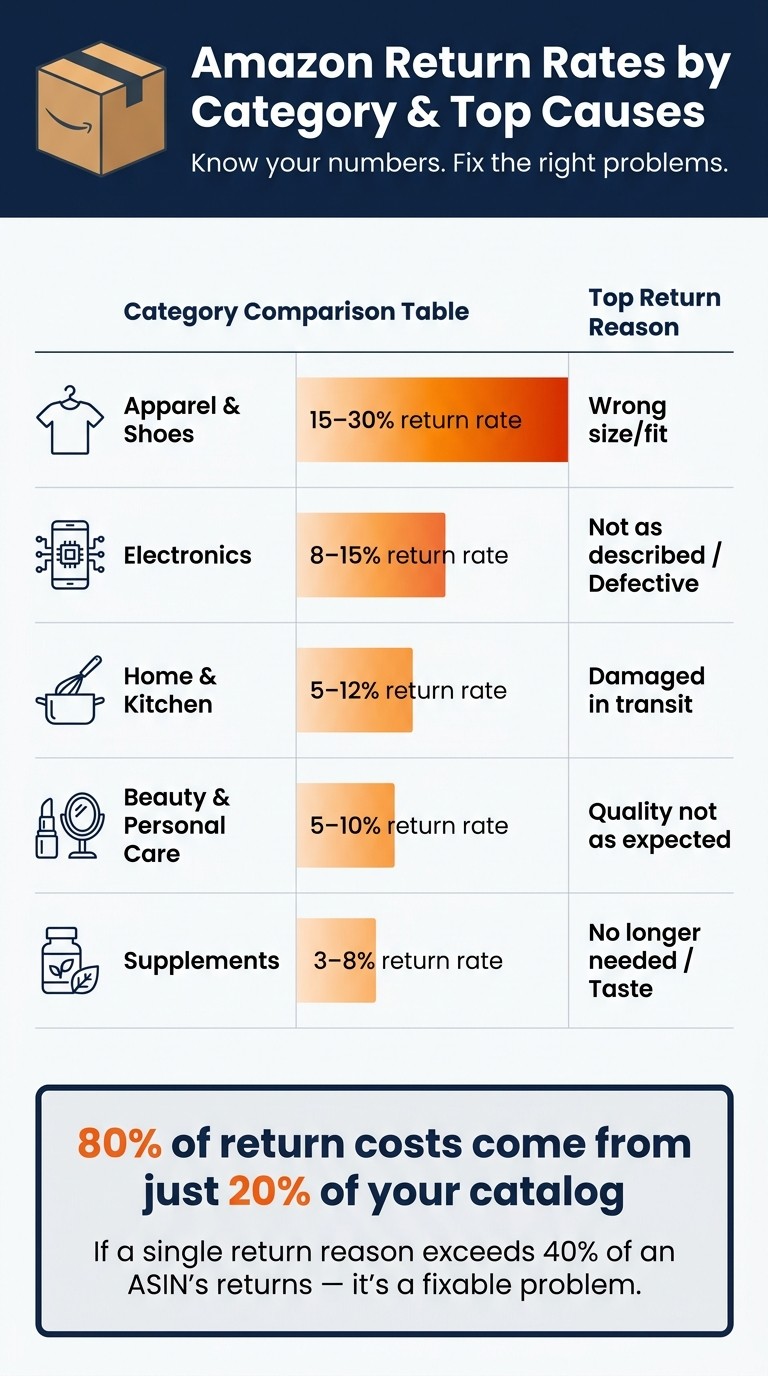
Amazon Return Rates by Category & Top Causes
Amazon Returns Costing Too Much? Here’s What You Can Do (Save Your Profits!) 417k Seller Reviews
1. Fix Your Product Detail Pages to Prevent Returns
One of the top reasons for returns on Amazon is an inaccurate product listing. Depending on the category, these errors account for 25–40% of returns. The good news? This issue can often be resolved with a more honest and detailed description of your product.
"Returns are a symptom, not a disease. The disease is a gap between customer expectation and product reality." - CSB Concepts
When customers return items marked as "smaller than expected" or "different from the photos", it’s usually a sign that the listing wasn’t clear enough. Providing more accurate details upfront can bridge this gap.
Take this example: In March 2023, a private label seller offering a bamboo desk organizer reduced their return rate from 18% to 8%. How? They added an image showing the organizer next to a standard keyboard for scale and included exact dimensions in the bullet points. Similarly, a clothing brand saw a 28% drop in returns for a popular jacket after adding the model’s height and chest measurements, along with a short fit video. These simple updates demonstrate how transparent and precise listings can significantly reduce returns.
"The cheapest way to reduce returns is to make your listing more honest." - Andrew Morgans, Founder of Marknology
Cost Reduction Potential
The potential savings here are substantial. By improving listing accuracy, you could cut returns due to inaccurate descriptions by 20–40%, which also means saving on processing, restocking, and disposal fees.
Ease of Implementation
This fix is relatively straightforward. Start by reviewing your return reason reports in Seller Central to identify common complaints. Then, update your listings with clearer photos, precise dimensions, detailed size charts, and better bullet points. Adding A+ Content can further reduce returns while increasing conversion rates.
Impact on Customer Satisfaction
When customers receive exactly what they expect, they’re more likely to leave positive reviews and shop with you again. Accurate product listings not only reduce negative feedback but also build long-term trust and stronger ratings.
2. Use Better Packaging to Reduce Damage and Waste
Even when product descriptions are accurate, damage during shipping can still lead to returns. Addressing this issue not only cuts return costs but also improves the customer experience. The good news? Unlike returns caused by description errors, damage-related returns can often be avoided with smarter packaging.
The first step is identifying the root of the problem. Did you know that nearly 40% of most e-commerce packages consist of empty space? This extra room allows products to shift around, increasing the chances of breakage, dents, and eventual returns. Plus, oversized packaging drives up shipping costs due to higher dimensional weight.
"Cheap packaging is effectively the most expensive component of your supply chain." - CNN Box
Switching to custom packaging can make a huge difference. For example, custom corrugated inserts, which cost just $0.10–$0.40 per unit, can reduce damage rates by over 70%. A Home Goods brand saw this firsthand in February 2026 when they swapped generic packaging for custom-engineered high-density E-flute board with die-cut inserts. The results? Breakage rates plummeted from 5% to 0.2%, fulfillment costs dropped by $0.80 per unit, and they doubled their storage capacity, slashing peak-season storage costs.
"We spent months renegotiating freight contracts to reduce damage, then solved 40% of the problem by redesigning the box." - Senior Packaging Engineer, North American Big-Box Retailer
Amazon’s Frustration-Free Packaging (FFP) is another example of how a small investment - $0.10–$0.30 per box - can lead to big savings. FFP can lower shipping costs by 20–30% and reduce damage rates by up to 73%. To get started, a packaging audit is key. Look for products with high damage-related return rates, then test whether using snugger boxes or custom inserts can solve the issue.
Cost Reduction Potential
The savings from better packaging add up quickly. Fewer damaged products mean fewer returns to handle, fewer items written off, and lower restocking costs. Plus, right-sizing packaging can shift products into a lower shipping tier, directly reducing fulfillment fees. For high-volume items, even a $0.50 savings per unit can translate into thousands of dollars in savings over just a few months.
Ease of Implementation
A packaging audit is a straightforward way to begin. Review your return reports and flag SKUs with frequent damage complaints. Then, partner with a packaging supplier to experiment with right-sized boxes or custom inserts. Most of the time, you won’t need a full product redesign - just a better fitment or a smaller outer box. Testing a small batch before scaling up minimizes risk and ensures you find the best solution.
Impact on Customer Satisfaction
Receiving a damaged product is one of the quickest ways to lose a customer’s trust. Unlike a listing error, this is something completely out of their control. Delivering products that are intact and thoughtfully packaged builds confidence in your brand. That trust often translates into repeat purchases and glowing reviews, which are crucial for maintaining strong rankings and conversions on platforms like Amazon.
3. Offer Partial Refunds and Keep-It Options
Beyond improving your listings and packaging, a returnless refund strategy can be a game-changer for cutting costs. Instead of requiring customers to send back an item, you can let them keep it while issuing a partial or full refund. This approach eliminates the expense of return shipping and handling, which can add up quickly. By combining this with enhanced product details and packaging, you can further reduce the costs tied to reverse logistics.
Here’s the reality: processing a return can cost anywhere from $15 to $20 per item. For lower-priced products - typically under $15–$18 - it’s often cheaper to refund the customer and skip the return altogether. Amazon has been refining its refund policies to make this easier. In September 2025, Amazon introduced a partial refund feature in Seller Central, allowing FBA sellers to offer refunds between 0% and 100% without requiring the product back. Then, in March 2026, Amazon expanded its returnless refund policy to include items valued at $25 or less.
"The partial refund feature gives Amazon FBA sellers a clean, data-driven way to tame return costs without sacrificing buyer trust." - Christina Chen, Author at Forest Shipping
Here’s a quick guide to setting refund thresholds:
Item Value | Suggested Partial Refund Range |
|---|---|
Under $25 | 25–40% |
$25–$75 | 30–60% |
Over $75 | 40–70% |
Cost Reduction Potential
Sellers using Amazon's returnless refund program have seen impressive results. One seller reported a 30% drop in return processing costs and a 25% boost in customer retention after offering partial refunds on low-value items. Since there are no extra fees beyond Amazon’s standard referral fees, this strategy is an affordable way to deal with returns.
Getting Started
Setting up partial refunds in Seller Central is straightforward. You can configure refund rules based on product categories or specific ASINs. Start by identifying products with high return rates, low resale value, or costly restocking fees. Focus on your most affordable, frequently returned items first, and expand the program once you see the savings add up. This process is simple and pairs well with other cost-saving strategies on Amazon.
Improved Customer Satisfaction
Returnless refunds don’t just save money - they also make customers happier. When buyers can keep an item and still get a refund, they avoid the hassle of repackaging and the wait for their refund to process.
"Returnless refunds enhance buyer satisfaction by offering immediate resolution to product complaints." - Kevin Celestine, Author of Amazon Returnless Refund Guide 2026
Research from the ECOSIRE Research Team found that customers offered a keep-it refund are twice as likely to leave a positive review and 40% more likely to make another purchase. This loyalty boost can easily offset the cost of refunding low-value items.
4. Educate Customers to Avoid Unnecessary Returns
After improving listings and packaging, the next step to reducing returns is educating customers. Many returns stem from misunderstandings about the product. In fact, "Not as described" returns account for 25–40% of all returns across most categories, and most of these can be avoided.
Including a scale reference image - like showing a product next to a coffee mug or keyboard - can reduce size-related returns by 12–18%. Similarly, using true-to-life photos taken in neutral lighting can decrease color-related returns by up to 40%. For instance, a kitchenware seller managed to cut size-related returns nearly in half by adding a dimensions infographic and a scale reference image to address complaints about items being "smaller than expected." Apparel listings can also benefit from tailored messaging to clarify size and fit.
"Returns are not a customer service issue. They are a creative and listing-strategy issue masquerading as one." - Velocity Sellers
For clothing, replacing vague fit descriptions with exact measurements can make a big difference. One apparel brand tracked by Seller Labs reduced its return rate from 30% to 14% in just eight weeks by including a "How to Measure" graphic and guidance on sizing up (Seller Labs, 2026).
Beyond visual aids, technical products can benefit from QR codes linking to setup videos, while detailed product comparisons using A+ Content can eliminate up to 25% of returns caused by user errors.
"The brands that use A+ content effectively treat it as return prevention, not just conversion optimization." - Canopy Management
Education Tool | Return Reason Addressed | Impact |
|---|---|---|
Scale reference images | Item too small/large | 12–18% reduction in size-related returns |
True-color photos | Color mismatch | Up to 40% reduction |
QR setup video guides | "Defective" (user error) | Prevents ~25% of electronics setup returns |
Detailed size charts + fit language | Wrong fit | Can lower apparel returns from 30% to 14% |
5. Streamline Your Return Policies and Processes
Just like fine-tuning product details and packaging, improving your return processes plays a big role in protecting your profit margins. While preventing returns is important, managing them efficiently when they do happen can make a big difference. Many sellers focus heavily on avoiding returns but often underestimate how much handling them can cost. For example, a single return on a $25 product can set you back $15–$20 when you factor in processing fees, lost inventory, and shipping. These costs can take a serious bite out of your profits.
Cutting Costs Where It Counts
Two tools can make a huge difference here: returnless refunds and SAFE-T claims. Setting up returnless refund rules for low-value items can save you $2–$5 per unit in FBA processing fees and completely eliminate reverse logistics costs. On the flip side, if a returned item is damaged, used, or swapped, you can file a SAFE-T claim within 60 days to recover your losses. With Amazon reducing the FBA reimbursement window from 18 months to just 60 days starting January 2025, conducting weekly audits is now more important than ever.
Making It Easy to Implement
The Amazon Prepaid Return Label (APRL) program has been mandatory for all U.S. sellers since February 8, 2026. This program automates label delivery to customers, cutting the refund cycle in half. To get started, set up returnless refund thresholds and workflows for SAFE-T claims as soon as possible. While the setup may take some time upfront, these processes require little manual effort once they’re in place. Additionally, the Guided Refund Workflow (GRW) allows you to evaluate the condition of returned items, apply restocking fees (if your policy allows), and document everything for potential disputes.
Boosting Customer Confidence
A faster refund process, such as a 7-day cycle compared to a 14-day one, can significantly increase buyer trust. Instant "keep-it" resolutions for low-value items also remove unnecessary friction. At the same time, having structured processes ensures your margins are protected by documenting return conditions and filing claims when necessary. The aim is to create a return policy that’s straightforward and quick for honest customers while being robust enough to handle problematic situations.
Here’s a quick breakdown of the key return processes:
Process | Time to Refund | Processing Fee | Best For |
|---|---|---|---|
Standard FBA Return | 7 days (via APRL) | $2–$5 | Higher-value items |
Returnless Refund | 1–2 business days | $0 | Items under $15–$18 |
FBM Return | 4 calendar days | Varies | Seller-fulfilled orders |
6. Use Return Data to Spot and Fix Recurring Problems
Every return tells a story, and it's your job to listen. Each return comes with a reason code, which you can find in the FBA Customer Returns Report in Seller Central. These codes reveal exactly where your product or listing might be falling short. If a single reason code makes up more than 40% of an ASIN's returns, it’s a red flag for an issue that can likely be resolved. By combining optimized listings with streamlined returns, analyzing this data helps you zero in on recurring problems.
Cost Reduction Potential
Here’s a key insight: 80% of return costs come from just 20% of your catalog. This means addressing a small group of problem ASINs can make a big difference to your bottom line. For example, "Not as described" returns account for 25–40% of all returns in many categories. These are often preventable with better descriptions or images. Take the case of a private label seller in a 2026 Seller Labs study. Their bamboo desk organizer had an 18% return rate, largely due to one recurring issue. Fixing that single problem significantly lowered returns. The takeaway? A targeted approach to problem ASINs can save you money.
Ease of Implementation
To stay on top of returns, audit your FBA Customer Returns report every two weeks. Focus on the top five ASINs by return volume. Then, cross-check the reason codes with your Voice of the Customer (VOC) dashboard, which provides CX Health scores and flags listings at risk of suppression. Don’t forget to check your Return Insights Dashboard (found under Inventory > FBA Returns) for return-rate percentages compared to category thresholds. This will help you decide which ASINs need immediate attention and which are performing within acceptable limits.
"Return rate is the single most under-measured lever in Amazon performance." - John Aspinall, Chief Evangelist & Creative Director, Velocity Sellers
Quick returns (within 48 hours) often point to packaging or first-impression issues, while returns after 20 days may indicate performance problems or buyer's remorse. By combining better packaging with smarter refund strategies, you can tackle these issues head-on and create a more effective returns reduction plan.
Impact on Customer Satisfaction
High return rates don’t just hurt your profits - they also affect your visibility. Amazon’s algorithm considers return rates when calculating organic rankings. Listings with return rates 1.5x above the category median for 90+ days see a median BSR drop of 22%. Even worse, Amazon may add a "Frequently Returned Item" badge to your listing, which can tank conversions. Solving these root causes not only improves the customer experience but also helps protect your listing’s performance.
Category | Avg. Return Rate | Top Return Reason |
|---|---|---|
Apparel & Shoes | 15–30% | Wrong size/fit |
Electronics | 8–15% | Not as described / Defective |
Home & Kitchen | 5–12% | Damaged in transit |
Beauty & Personal Care | 5–10% | Quality not as expected |
Supplements | 3–8% | No longer needed / Taste |
7. Get Expert Help from Agencies like eStore Factory

Sometimes, even after applying all the strategies you can think of, managing returns still feels like an uphill battle. That’s where professional help comes in. Agencies like eStore Factory can take your returns management to the next level by addressing challenges from multiple angles - whether it’s improving your listings, refining ad targeting, maintaining account health, or recovering lost FBA reimbursements.
Cost Reduction Potential
Professional audits can make a big difference. In fact, they can lower return rates by 30–45% in just one quarter. Plus, many sellers lose between 1–3% of their annual revenue due to FBA inventory errors or unrecovered reimbursements. That’s money left on the table! eStore Factory’s Refunzo app is designed to tackle this issue. It scans 21 different criteria to identify return discrepancies and boasts a 96% success rate in recovering eligible FBA refunds. And the best part? Their reimbursement service runs on a contingency model - charging 15% of the recovered amount (capped at $5,000), so there’s no upfront cost.
Another common issue? Ineffective ad targeting, which often leads to unnecessary returns. eStore Factory’s AI-powered SellerQI tool directly addresses this by optimizing ad spend. For example, in a recent performance review (ending November 2025), a US-based foot care brand saw their ACoS drop from 52.66% to 33.42%. This was achieved by eliminating zero-sale search terms and reallocating budgets toward high-intent keywords. The result? A 9.6% month-over-month increase in total sales.
Ease of Implementation
The process is designed to be stress-free for sellers. eStore Factory begins with an account audit to pinpoint high-return ASINs and then implements targeted solutions. From rewriting bullet points to sourcing better product photography, their team handles everything. This hands-off approach doesn’t just save you time - it ensures that every fix is tailored to resonate with your customers.
"Strong results come from clarity and consistency. SellerQI provides real-time insights. When the focus stays on what converts, what does not, and how shoppers actually behave, backed by AI that catches problems in real time, efficiency improves naturally." - Jimi Patel, Founder, eStore Factory
Impact on Customer Satisfaction
Reducing returns isn’t just about cutting costs - it’s also about improving the customer experience. eStore Factory focuses on fixing the root causes of returns, such as misleading descriptions, poor-quality images, or unclear sizing details. Their work includes creating detailed "items in the box" descriptions, clear usage instructions, and enhanced visual content like infographics and lifestyle images. This level of detail helps shoppers know exactly what they’re buying.
When customers receive what they expect, it leads to fewer surprises, fewer returns, and better reviews. Plus, it lowers the risk of Amazon slapping a "Frequently Returned Item" badge on your product - a label that can cut your conversions by 30–50%.
Conclusion
Amazon returns aren't just about customer satisfaction - they're a direct hit to your bottom line. For instance, a single return on a $30 product can lead to losses of up to $17.64 per sale. This includes processing fees, non-refundable FBA fees, and inventory that can't be resold. That's nearly 60% of the product's value gone.
These numbers highlight why addressing returns isn't optional. The strategies discussed earlier focus on tackling the root causes of returns rather than just managing the fallout. Approaches like offering partial refunds or tightening return policies can act as safeguards, but they work best when paired with proactive solutions.
One key differentiator for successful sellers lies in how they handle return data. Raj Patel, Director of Operations at Threshold Commerce Group, emphasizes this shift:
"The brands that are winning on returns in 2026 have stopped treating it as a cost center and started treating it as a data source."
This mindset makes regular audits critical. By reviewing your FBA Customer Returns report every two weeks, you can catch issues with specific ASINs before Amazon intervenes. Ignoring these insights can lead to suppressed listings or a dreaded "Frequently Returned Item" badge, which can slash conversions by 30–50%. And when return rates for a product stay 1.5 times above the category median for over 90 days, the median BSR drops by 22%. Early intervention is not just smart - it’s necessary.
No single fix will solve the problem. A comprehensive strategy is key. Combining accurate product listings, better packaging, return data analysis, and FBA reimbursement recovery can break the cycle of rising costs and poor performance. Agencies like eStore Factory can help you align these efforts, ensuring your processes work together to protect your profits. Start small, implement these methods step by step, and track your progress along the way.
FAQs
When should I use a returnless or partial refund?
When the cost of managing a return - think shipping, storage, and handling fees - outweighs the profit from the item, a returnless refund can be a smart choice. This approach is ideal for items that are low in value or difficult to resell.
For higher-priced or bulky products, like furniture or large appliances, partial refunds might make more sense. These are especially useful in situations where return shipping is expensive or when the product has minor damage or has been opened.
Which return reports in Seller Central matter most?
To dive into return data, start by reviewing the FBA Customer Returns report under Reports > Fulfillment or look at the Return Reports section for FBM. For a more detailed view, use the Returns and Recovery: Insights and Opportunities dashboard, which highlights trends, costs, and actionable recommendations.
Make sure to download data from the last 90 days, segment it by ASIN and return reason codes, and then cross-check this information with the Voice of the Customer dashboard. This will help pinpoint potential quality issues or inaccuracies in your product listings.
How do I stop Amazon from flagging my item as 'Frequently Returned'?
If you want to avoid having your items labeled as 'Frequently Returned,' it's all about addressing customer concerns and ensuring your product meets expectations. Here's how:
Audit Your Product Listings: Start by reviewing your product titles, images, and descriptions. Make sure they accurately represent what customers are purchasing. Misleading or unclear information often leads to returns.
Leverage Seller Central Tools: Use the Returns Report and Voice of the Customer data available in Seller Central. These tools can help you pinpoint common customer complaints and identify patterns.
Dive Into Reviews: Negative reviews can be a goldmine of insights. Look for recurring issues - whether it's product defects, misleading descriptions, or unmet expectations - and address them directly.
Collaborate With Manufacturers: If defects are a recurring problem, work closely with your manufacturer to resolve these issues. Product quality is key to reducing returns.
Consider Removing Problematic SKUs: If a product continues to generate complaints and returns despite your efforts, it might be time to remove that SKU altogether. This can help protect your account health and overall seller reputation.
Taking these steps not only minimizes returns but also helps build trust with your customers.






