


E-Commerce Strategies
Amazon sellers in 2025 are leveraging smarter keyword strategies to stay competitive. The focus has shifted from just search volume to understanding buyer intent, external traffic, and engagement metrics. Key trends include AI-powered tools for real-time insights, prioritizing long-tail keywords for higher conversions, and using Amazon Brand Analytics for first-party data. Sellers are also refining their listings and PPC campaigns based on competitor analysis tools like Helium 10 and Jungle Scout.
Quick Takeaways:
AI tools like Helium 10 enable faster, deeper competitor keyword analysis.
Long-tail keywords (e.g., "non-slip yoga mat for home workouts") convert 5%-25%, outperforming short-tail keywords.
Amazon Brand Analytics offers accurate customer behavior data, improving keyword targeting.
Reverse-ASIN analysis helps identify gaps in your keyword strategy.
Keyword placement matters: Titles, bullet points, backend search terms, and PPC campaigns should align with buyer intent.
By following these trends, sellers can improve their organic rankings and reduce ad spend. Start by analyzing competitor ASINs, segmenting keywords by ROI, and optimizing listings for Amazon’s updated A10 algorithm.
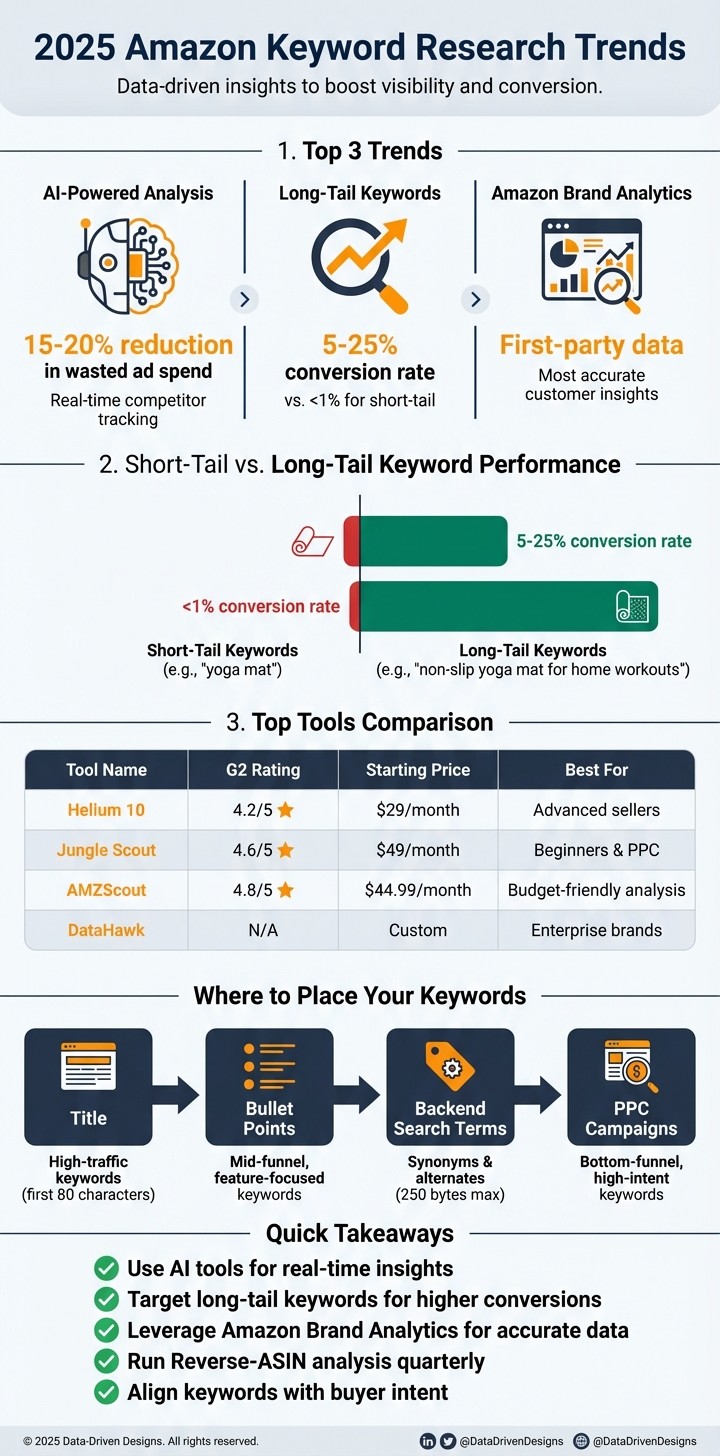
2025 Amazon Keyword Research Trends and Conversion Rates Comparison
4 Ways to Find Hidden Amazon Keywords Your Competitors Missed
Top Trends in Amazon Competitor Keyword Research for 2025
The way sellers approach competitor keyword research has shifted dramatically this year. Relying on outdated methods could leave you lagging behind competitors who are leveraging advanced tools and strategies. Here are three key trends shaping how successful Amazon sellers are staying ahead in 2025. These trends reflect the impact of recent algorithm updates and refined SEO practices.
AI-Powered Keyword Analysis
Artificial intelligence has transformed the efficiency and depth of keyword research. While manual methods might cover a few hundred keywords, AI tools can analyze millions in mere minutes. But it’s not just about scale - AI uncovers patterns that human researchers often miss.
One standout benefit is real-time tracking. AI tools monitor competitors' pricing, inventory, and marketing changes, enabling sellers to adapt instantly rather than relying on outdated reports. Lauren Stair, a Marketing Expert at Helium 10, highlights this shift:
"If you're still doing monthly keyword reviews in Excel, you're operating with 30-day-old intelligence in a market that shifts daily."
AI also predicts seasonal demand trends and competitor actions. Features like semantic mapping group related terms - such as "waterproof speaker" and "shower speaker" - to reflect buyer intent. With Amazon's Rufus assistant gaining popularity, AI tools now optimize for conversational queries, aligning with how shoppers naturally search. Additionally, AI-driven negative keyword management helps sellers cut wasted ad spend by 15% to 20%, automatically removing terms that generate clicks but no sales.
Growing Focus on Long-Tail Keywords
Thanks to AI insights, sellers are prioritizing precision over volume. Competing for generic, high-traffic keywords is a losing game for most, as these terms are dominated by big players. Instead, savvy sellers are targeting long-tail keywords - specific 3–5-word phrases aimed at ready-to-buy shoppers. For instance, "yoga mat" might drive broad impressions, but "non-slip yoga mat for home workouts" attracts customers who know exactly what they’re looking for.
The numbers back this up. Short-tail keywords typically convert at under 1%, while long-tail phrases can achieve conversion rates of 5% to 25%. With less competition, these terms provide opportunities for smaller sellers to rank without needing massive ad budgets or thousands of reviews. The rise of conversational search, spurred by AI assistants like Rufus, has further fueled this trend. Shoppers are now asking full questions, and sellers who incorporate natural-language phrases into their listings are capturing traffic that traditional keyword strategies miss.
Amazon Brand Analytics as a Data Source

Third-party tools have long been a staple for keyword research, but they rely on estimates and algorithms. Amazon Brand Analytics (ABA), on the other hand, provides first-party data directly from Amazon, making it the most reliable source for understanding customer behavior. As Shaival Choksi explains:
"Unlike third-party tools, Brand Analytics provides first-party search data directly from Amazon, ensuring more accurate insights into customer behavior and search trends."
ABA’s value lies in its ability to expose performance gaps. By analyzing competitor ASINs, sellers can uncover high-performing keywords that might otherwise go unnoticed. With conversational search on the rise, ABA becomes even more critical for identifying natural-language and question-based phrases that resonate with today’s shoppers. This data equips sellers to refine their product listings and PPC campaigns with precision, adapting quickly to shifting trends in their category.
Tools and Methods for Competitor Keyword Research
Staying ahead in 2025 requires more than just basic keyword research. Modern tools and techniques now provide deeper insights into your competitors' keyword strategies, helping you uncover opportunities and refine your own Amazon SEO strategy.
Reverse-ASIN Analysis
Reverse-ASIN analysis is like getting a behind-the-scenes look at your competitors' keyword strategies. Using tools like Helium 10's Cerebro, you can input 3–10 competitor ASINs to discover all the keywords their products rank for - whether organically or through sponsored ads. This method is especially useful for spotting keyword gaps: terms where your competitors rank highly, but your product doesn't appear.
For example, you can extract over 1,000 keywords from 10 competitor ASINs in just minutes. From there, narrow it down to 50–100 key terms that align with your product's features. Focus on relevance and buyer intent rather than just search volume. As Ash Metry, Founder & CEO of Keywords.am, explains:
"In 2026, Amazon cares more about what buyers want and how well your listing converts clicks into sales, not just raw search volume."
Helium 10 also helps you identify which keywords drive conversions, not just traffic. Since competitor strategies and seasonal trends change quickly, it's smart to run this analysis at least every quarter.
Analyzing Competitor Listing Content
Take a closer look at competitors who hold "Best Seller" or "Amazon's Choice" badges or rank on the first two search pages. Their listings can reveal a wealth of information about effective keyword usage.
Titles: Highlight primary keywords.
Bullet Points: Focus on feature-driven phrases.
Descriptions: Include technical details and synonyms.
Dive deeper into customer reviews, Q&A sections, and A+ Content. Positive reviews often highlight benefit-focused language, while negative reviews can uncover problem-solving keywords your competitors may have overlooked. The "Customer questions & answers" section is another goldmine for identifying informational keywords that address common shopper concerns.
Don't forget to review A+ Content and comparison charts. These elements often showcase how competitors position their products and which secondary keywords they emphasize. With AI tools, you can now analyze thousands of reviews in minutes, identifying keyword clusters and sentiment trends that would otherwise take days to uncover.
Leading Tools for 2025
The right tool depends on your goals and level of expertise. Here’s a breakdown of some top options:
Helium 10: A favorite among advanced sellers, Helium 10 offers features like Cerebro for reverse-ASIN analysis and Magnet for expanding seed keywords. With a 4.2/5 G2 rating and plans starting at $29/month, it boasts a massive database and robust filtering options.
Jungle Scout: With a 4.6/5 G2 rating, Jungle Scout is ideal for beginners and PPC-focused sellers. Its Keyword Scout feature provides accurate search volume data and historical trends. Plans start at $49/month.
DataHawk: Tailored for larger brands, DataHawk includes advanced "Share of Voice" analytics and AI-driven content recommendations.
AMZScout: With a 4.8/5 G2 rating, AMZScout offers a budget-friendly Chrome extension ($44.99/month) for real-time competitor analysis directly on Amazon search pages.
These tools have evolved far beyond simple keyword lookups. Now, they incorporate AI-driven features like semantic keyword discovery, listing optimization, and access to Amazon's Brand Analytics data. The key is choosing a tool that fits your workflow - whether you need Helium 10 for in-depth analysis, Jungle Scout for ease of use, or DataHawk for enterprise-level insights.
How to Prioritize and Use Competitor Keyword Data
Making the most of competitor keyword data is all about smart prioritization. Once you've gathered a list of keywords, the challenge is figuring out which ones deserve your attention. The trick? Focus on keywords that offer the most value, using segmentation to organize them based on their potential impact. This approach helps align your SEO and PPC strategies for better results.
Keyword Segmentation Methods
Grouping keywords into categories can sharpen your strategy and make it easier to act on the data. Here are three key categories to consider:
High-ROI Keywords: These have strong search volume, high conversion potential, and manageable competition. They should be your primary focus.
Opportunity Keywords: These are terms where your competitors rank well, but your listing is missing or underperforming. Closing the gap here can mean quick wins.
Exploratory Keywords: These target niche audiences or emerging trends. While they may have lower search volume, they can help you tap into new markets.
A helpful tool for prioritization is the Cerebro Product Rank (CPR) metric, which estimates how many units you need to sell to rank on page one. For example, if a keyword requires 500 units to rank but your weekly sales are only 50, it might not be realistic for organic ranking right now. Instead, focus on keywords where the CPR matches your current sales pace or reserve high-CPR terms for paid campaigns.
Another way to segment keywords is by buyer intent:
Top-Funnel Keywords: These attract shoppers in the research phase (e.g., "best wireless earbuds"). Use them in A+ Content and Sponsored Display ads.
Mid-Funnel Keywords: These indicate comparison shopping (e.g., "wireless earbuds with noise cancellation"). They work well in bullet points and Sponsored Products campaigns with broad or auto targeting.
Bottom-Funnel Keywords: These show purchase intent (e.g., "Sony WH-1000XM5 alternative"). Include these in your title, backend search terms, and exact-match PPC campaigns.
Once you've segmented your keywords, the next step is integrating them into your listings effectively.
Adding Keywords to Your Listings
When optimizing your product listings, placement is key. Here's how to make the most of your keywords:
Title: Prioritize high-traffic keywords in the first 80 characters. For instance, if "stainless steel water bottle 32 oz insulated" is a top-performing keyword, place it prominently at the beginning of your title.
Bullet Points: Use feature-focused, mid-funnel keywords here. Instead of vague descriptions like "keeps drinks cold", go for specifics like "double-wall vacuum insulation maintains temperature for 24 hours." Pull these phrases from competitor listings that have earned "Best Seller" or "Amazon's Choice" badges - they've already proven effective.
Backend Search Terms: This hidden field allows for up to 250 bytes of additional keywords. Use it for synonyms, alternate spellings, and secondary keywords that don't fit naturally into your title or bullets. Avoid repeating terms already in your listing, as Amazon's algorithm only needs to see a keyword once to index it.
Using Keywords in PPC Campaigns
After optimizing your listings, apply your keywords to PPC campaigns to maximize their impact. Competitor keywords are especially effective in Sponsored Products campaigns. Start with exact-match campaigns targeting bottom-funnel keywords, as these often deliver higher conversion rates and lower ACoS (Advertising Cost of Sale). For instance, if "leak-proof gym water bottle" is a strong competitor keyword, bid aggressively on it to attract ready-to-buy shoppers.
Monitor your search term reports weekly to spot high-performing queries. Move these into dedicated exact-match campaigns for better control and efficiency. This iterative process ensures your strategy evolves based on real performance data.
For top-funnel keywords, consider using Sponsored Display and video ads. These are great for building awareness among shoppers in the early stages of their buying journey. Since over half of all online shoppers start their product searches on Amazon, capturing their attention early can have a big impact later. Pair these campaigns with lifestyle imagery in your A+ Content to strengthen your brand presence across multiple touchpoints.
Conclusion
Main Takeaways for 2025
Amazon’s keyword landscape is evolving rapidly, and staying ahead means adjusting your research methods to keep pace. With the transition from the A9 to A10 algorithm, keyword strategy now hinges on intent rather than sheer search volume. High-intent keywords, which align closely with buyer behavior and conversion likelihood, have become far more valuable than outdated keyword-stuffing tactics.
To stay competitive, combining AI tools with manual research is the way forward. AI tools can sift through countless customer reviews to reveal the authentic language shoppers use, while Reverse ASIN lookup offers hard data on what’s working for your competitors. It’s also essential to map keywords to the buyer journey: use top-funnel keywords in A+ Content, mid-funnel keywords in bullet points, and bottom-funnel transactional keywords in titles and exact-match PPC campaigns.
These strategies provide a clear path to refining your approach and boosting your Amazon success.
Next Steps for Amazon Sellers
Now’s the time to act. Begin with a Reverse ASIN gap analysis to uncover high-performing keywords you’re not yet targeting. Start with realistic goals, focusing on attainable keywords, and then expand to include more competitive terms as you gain traction.
For expert support in navigating Amazon’s shifting keyword strategies, reach out to eStore Factory. Their team specializes in Amazon SEO and PPC management, offering everything from listing optimization to data-driven advertising strategies tailored to the priorities of 2025.
FAQs
How do I find competitor keywords that actually convert?
To uncover competitor keywords that drive conversions on Amazon in 2025, shift your attention to buyer intent and post-click performance rather than just chasing high search volume. Leverage tools like Amazon Brand Analytics and PPC auto campaigns to pinpoint keywords that are delivering strong results. Study competitor listings closely to reverse-engineer their ranking strategies. Focus on long-tail or niche keywords that match your product's unique features and your target audience's needs - this approach can help you drive better conversions.
What’s the easiest way to do a Reverse-ASIN gap analysis?
Using specialized tools is the simplest way to handle a Reverse-ASIN gap analysis in 2025. These tools streamline the process, helping you uncover competitors' top-performing keywords in no time. This approach eliminates much of the guesswork, allowing you to focus on results.
By carefully analyzing the data these tools provide, you can strategically incorporate high-performing keywords into your product listings. This ensures your content aligns with Amazon's emphasis on relevance and user intent - without falling into the trap of keyword stuffing.
How can I prioritize long-tail keywords without hurting my rankings?
To make the most of long-tail keywords, focus on incorporating these intent-focused phrases into your product listings and PPC campaigns. Tools like Helium 10, Jungle Scout, or Amazon Brand Analytics can help you discover relevant terms. Once identified, strategically place these keywords in your product titles, bullet points, descriptions, and backend search terms.
Keep an eye on competitor listings and analyze search term reports regularly. This helps you fine-tune your approach, ensuring your keywords remain relevant and effective. The key is to improve visibility and conversions without overloading your content with unnecessary keywords.






