


E-Commerce Strategies
A+ Content on Amazon can boost sales by up to 20% when done right. But expanding globally? That’s where localization comes in. Here’s the key: 76% of shoppers prefer content in their native language, and proper localization can increase conversions by 40%. Localization isn’t just about translating text - it’s about tailoring visuals, measurements, and even tone to match local preferences. For example, German shoppers value technical details, while Japanese customers expect detailed product photography (see these Amazon EBC examples for inspiration).
Key takeaways:
Localization matters: Adjust language, visuals, and even pricing for each market.
Compliance is critical: Each country has specific regulatory requirements (e.g., CE mark for the EU, PSE mark for Japan).
SEO is local: Translate keywords based on search habits, not just language.
Amazon tools help: Use features like "A+ Cross-country Copy-as-a-draft" to streamline the process.
Global A+ Content isn’t just about selling - it’s about meeting customer expectations in every market. Let’s dive into the details.
A+ Content Requirements for Different Amazon Marketplaces
Amazon Brand Registry Requirements

To create A+ Content, you first need to enroll in the Amazon Brand Registry. This service is free, provided you meet certain criteria. One key requirement is having an active or pending trademark - whether text-based or image-based - for every country where you sell.
Your brand name or logo must be permanently applied to your products or packaging. Methods like printing, sewing, or etching are acceptable, but stickers, labels, or stamps are not. Additionally, the brand name you submit must match your trademark exactly, including spaces and symbols (capitalization differences are allowed). During the enrollment process, Amazon sends a verification code to the public contact listed for your trademark, so make sure this information is up to date.
"Amazon Brand Registry has been a huge leap forward for Casio in protecting our intellectual property. The response time has been lightning fast and the team assigned to this program are incredibly knowledgeable and efficient." - Casio
If you don’t have a trademark yet, Amazon offers the IP Accelerator program. This connects you with vetted legal service providers who handle trademark registration. While the program itself is free to access, legal providers charge pre-negotiated rates for their services. The major benefit? You can enjoy Brand Registry benefits while your trademark application is still pending, instead of waiting months for approval.
Once enrolled, you can evaluate the benefits of Brand Registry and confirm eligibility for A+ Content in your target marketplaces.
Which Marketplaces Support A+ Content
A+ Content is available in major Amazon regions, including the United States, United Kingdom, European Union (Germany, France, Italy, Spain), Australia, UAE, and India. To access this feature in any marketplace, you need a Professional selling account and must be enrolled in Brand Registry as either a Rights Owner or Brand Representative for that region.
Each marketplace requires A+ Content to be submitted in its primary language. For example:
English for Amazon.co.uk
German for Amazon.de
French for Amazon.fr
Japanese for Amazon.co.jp
Additionally, you’ll need an active trademark registered in the specific country or region where you plan to sell. For instance, selling in Germany requires a trademark registered with either the European Union Intellectual Property Office (EUIPO) or the German Patent and Trade Mark Office.
Amazon generally reviews and approves A+ Content submissions within seven business days. To streamline localization, you can use the "A+ Cross-country Copy-as-a-draft" feature. This tool allows you to create draft versions of approved content for other marketplaces linked to your account. However, keep in mind that A+ Content is not supported for products in the Books, Music, Video, and DVD (BMVD) categories across any marketplace.
Amazon A+ Content Localization: An Essential Strategy for Global Success
How to Localize A+ Content for Different Countries
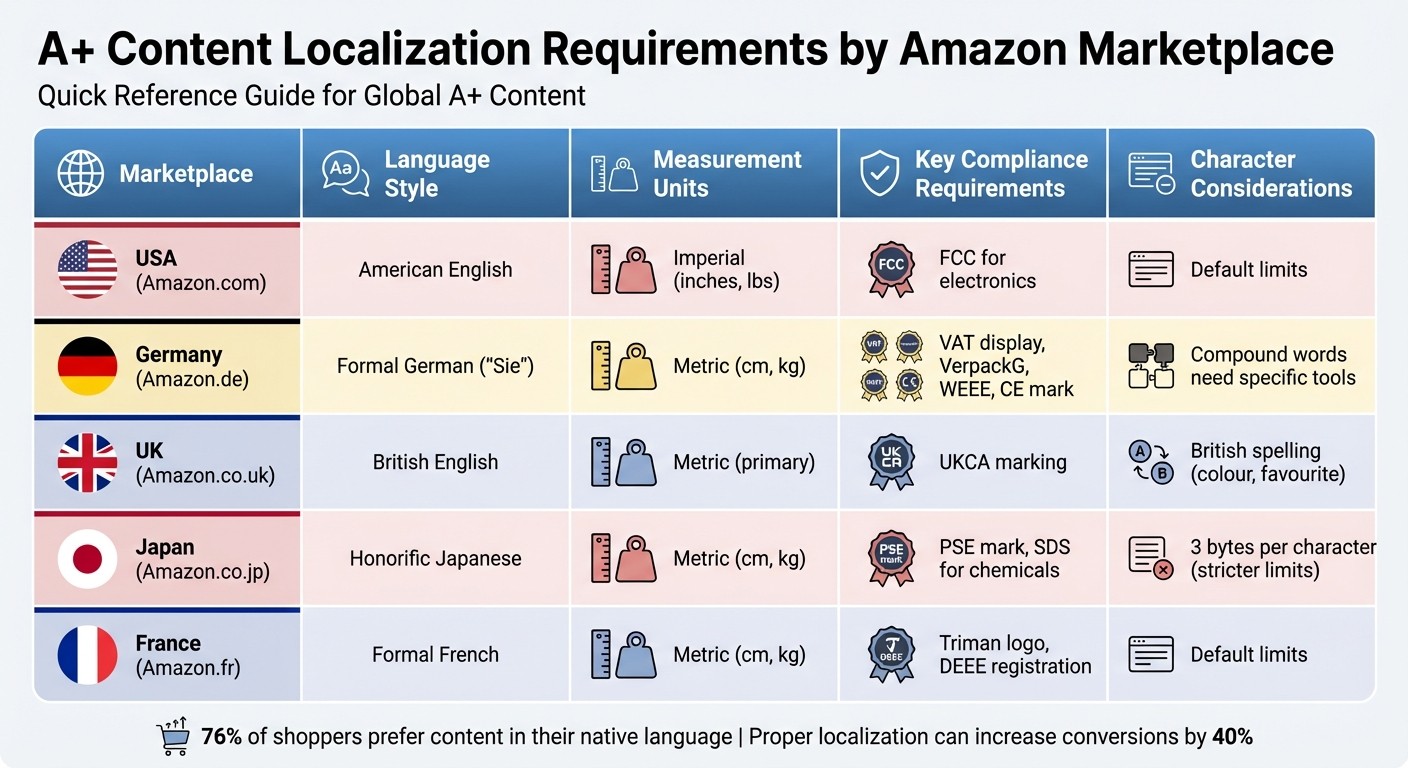
A+ Content Localization Requirements by Amazon Marketplace
Adjusting Text and Images for Local Markets
When localizing your A+ Content, you're tailoring text, tone, visuals, and cultural cues to meet the preferences of specific regions. This isn't just a nice touch - it can significantly improve conversion rates, as shoppers are far more likely to trust and purchase from content presented in their native language.
Start by refining your messaging style. For example, an energetic, sales-driven tone that works well in the U.S. might feel overbearing to European audiences, who often prefer concise, technical information. On the other hand, Japanese consumers typically appreciate detailed, long-form content. Derek Gleason, Senior Content Lead at Shopify, explains:
"Japanese consumers tend to prefer longer-form content... You might combine several short blogs into one longer article for Japanese markets because that kind of content performs better there."
Don't overlook visuals. Images should align with the target market's preferences and demographics. For example, models in your photos should reflect the local population. Additionally, translate text embedded in videos or infographics - automated tools often miss these details. Lifestyle images should also resonate with the local audience, reflecting their living standards and cultural norms.
Keyword research is another crucial step. Direct translations might not cut it. For instance, in Germany, "Handyhülle" is used for phone cases, while in the UK, "pushchair" refers to a stroller. As LEaF Translations puts it:
"You translate text, you localise keywords."
German keywords often include long compound words like "Bio-Baumwollbabydecke" (organic cotton baby blanket), which require specialized tools to identify. By customizing your text and visuals, you'll lay the groundwork for more precise localization, including pricing and regulatory details.
Using Local Currency, Units, and Language
Localization goes beyond words and images - it’s about getting the numbers and language nuances right, too. Display prices in the local currency - USD for the U.S., GBP for the UK, EUR for European countries - and include taxes like VAT upfront. This transparency builds trust. Similarly, adapt measurement units: use imperial (inches, pounds, gallons) for the U.S., but switch to metric (centimeters, kilograms, liters) for European and Asian markets.
Language nuances also matter. In Germany, formal address ("Sie") is standard, while in Japan, honorific language ("keigo") is essential. Adjust spelling for regional variations, like "color" in the U.S. versus "colour" in the UK. Amazon Japan has stricter character limits due to byte-based measurements - every Japanese character counts as three bytes, meaning a 250-byte limit allows for about 83 characters.
Regulatory compliance is non-negotiable. Make sure to include necessary local markings in your content. For instance, the CE mark is required for the EU, the PSE mark for Japan, the UKCA marking for the UK, and the Triman logo for France. Non-compliance can have serious consequences; in 2024, 37% of sellers in Japan were delisted due to improper labeling or missing safety marks.
Amazon offers tools to simplify this process. The "A+ Cross-country Copy-as-a-draft" feature allows you to replicate content across regions, while the A+ Content Manager’s "Add a new language" option or using professional A+ Content services lets you customize content for specific languages within the same marketplace.
Localization Comparison Table by Marketplace
This table highlights the key adjustments needed for different Amazon marketplaces, including language styles, measurement units, and compliance requirements:
Marketplace | Language Style | Measurement Units | Key Compliance Requirements | Character Considerations |
|---|---|---|---|---|
USA (Amazon.com) | American English | Imperial (inches, lbs) | FCC for electronics | Default limits |
Germany (Amazon.de) | Formal German ("Sie") | Metric (cm, kg) | VAT display, VerpackG, WEEE, CE mark | Compound words need specific tools |
UK (Amazon.co.uk) | British English | Metric (primary) | UKCA marking | British spelling (colour, favourite) |
Japan (Amazon.co.jp) | Honorific Japanese | Metric (cm, kg) | PSE mark, SDS for chemicals | 3 bytes per character (stricter limits) |
France (Amazon.fr) | Formal French | Metric (cm, kg) | Triman logo, DEEE registration | Default limits |
SEO and Keyword Strategies for International Markets
Finding Keywords for Each Target Market
When expanding into international markets, avoid simply translating your keywords. Instead, focus on terms that resonate locally. Why? Because 76% of shoppers prefer product details in their native language, and their searches reflect their unique habits and preferences. For instance, while "running shoes" translates to "Laufschuhe" in German, German shoppers are more likely to search for "Sportschuhe" (sport shoes) or "Joggingschuhe."
A good starting point is analyzing local search results. Adjust your Google Search settings to the target country and language, or use a VPN to uncover autocomplete suggestions and "People Also Ask" questions. This helps you see how local users phrase their searches. For example, in the UK, parents search for "pushchair" instead of "stroller", and "nappies" instead of "diapers." These aren't just spelling differences - they're entirely different terms that could make or break your visibility.
Don't overlook regional search engines. While Google is dominant in many markets, others like Baidu in China (used by about 70% of Chinese internet users) and Yandex in Russia (preferred by nearly 50% of Russian users) play a major role. If you're targeting these regions, it's essential to optimize for their specific algorithms. However, for sellers focusing on Europe, Japan, and North America, Google remains the go-to for keyword research.
Collaborating with native speakers or local experts is invaluable. Automated tools often miss subtle nuances and synonyms that locals naturally use. Shaheen Samavati, CEO of VeraContent, emphasizes this point:
"As multilingual marketers, we can't be experts in every language and market. But we can be experts at finding the right professionals who are."
Some markets pose unique challenges. In Germany, you'll encounter long compound words like "Bio-Baumwollbabydecke" (organic cotton baby blanket) that require specialized tools to break down effectively. Japan, on the other hand, uses three writing systems - Hiragana, Katakana, and Kanji - and even spacing between characters can impact search results. Additionally, Japan's 250-byte limit for keywords means you can only fit about 83 characters, as each Japanese character takes up 3 bytes.
Use these insights to embed well-researched, localized keywords across all your content elements.
Adding Keywords to Alt-Text and Headings
Once you've done your keyword research, ensure that every searchable element of your content reflects the local language and its unique nuances. Amazon's algorithm treats backend keywords and image alt-text as separate entities for each marketplace, so these elements need to be localized to perform effectively. Alt-text, while invisible to shoppers, plays a critical role in search rankings and accessibility, making it a perfect place to include high-volume localized keywords.
Don't stop at alt-text - localize all text within images, such as infographics or callouts. If your U.S. content features lifestyle images with text overlays highlighting product benefits, recreate those with localized terms that match what local shoppers are searching for. This isn’t just about translating words - it’s about using the exact phrases that customers type into search bars.
Pay close attention to backend search terms, too. These should be updated to reflect the local language and incorporate the keywords you've identified, rather than relying on direct translations. For instance, when British fashion label Represent localized its content for the German market in December 2025, it saw a 30% boost in conversions and doubled its organic traffic.
After implementing these changes, monitor your rankings and conversions over 30–60 days and adjust as needed. For example, a seller of seasonal mosquito nets in Europe used localized keywords like the Turkish "sineklik" (fly screen). This targeted strategy reduced their Advertising Cost of Sales (ACOS) from 68% to 38%. As LEaF Translations aptly puts it:
"You translate text, you localise keywords."
Testing, Submitting, and Tracking A+ Content Performance
Testing A+ Content Across Multiple Markets
Once you've tailored your text, visuals, and keywords for specific markets, the next step is to test and tweak your A+ Content before submitting it. One of the best tools for this is Amazon's Manage Your Experiments (MYE). This free A/B testing tool is available to sellers enrolled in Brand Registry with Professional accounts. It allows you to directly compare two versions of your content to see which one performs better. To get meaningful results, make sure Version B is noticeably different from Version A - Amazon will notify you if the two versions are too similar.
Experiments typically take 4 to 10 weeks to yield statistically reliable results. According to Amazon, A/B testing can boost sales by as much as 25%, making it a valuable step in the process. Ben Huge, Brand Manager at Onkata Hardware Sales, Inc., highlights its importance:
"With Manage Your Experiments, we can explain what's going on in a customer's marketplace. We justify the changes or recommendations we want to make thanks to the data Manage Your Experiments produces."
Before finalizing your content, preview it on both desktop and mobile devices using the A+ Content Manager. This ensures it looks clean and readable across platforms. Avoid adding text directly into images, as it may become unreadable on smaller screens or when resized. Instead, use Amazon’s text modules to maintain clarity and consistency.
Once you've tested and refined your content, you're ready to submit it for review.
Submitting Content and Handling Rejections
Thorough testing makes the submission process much smoother, especially when targeting multiple marketplaces. After confirming your content's performance, submit it for approval. Amazon simplifies this by creating automatic draft copies for other marketplaces. For instance, once your content is approved in US English, drafts are generated for regions like Canada, the UK, Germany, Australia, and others. You can then localize these drafts to fit the specific language and cultural norms of each marketplace.
Keep in mind that each marketplace has its own set of rules. Common reasons for rejections include using the wrong language (e.g., German is required for Amazon.de), making unsupported claims like "best-selling", including contact details, or uploading low-quality images. To prevent issues, review the regional guidelines before submitting. If your content is rejected, Amazon provides detailed feedback, allowing you to make corrections and resubmit. You also have the option to save your work as a draft if you need more time to refine translations or visuals.
Once approved, use tools like Amazon Brand Analytics and the MYE dashboard to track how your content performs. These tools provide insights into metrics like conversion rates, units sold, and projected sales impact over the next year. For a broader view, integrate platforms like Google Search Console and Google Analytics 4 to monitor visibility and user engagement in international markets.
How eStore Factory Helps Scale A+ Content Globally

eStore Factory simplifies the complex process of scaling A+ Content across multiple international marketplaces, providing tailored solutions to meet the unique demands of each region.
eStore Factory's Global A+ Content Services
Creating A+ Content for one market is no small feat, but expanding it globally? That’s a whole new level of complexity. eStore Factory steps in with end-to-end services designed to help Amazon sellers navigate this challenge. They focus on localization and compliance, adapting your content to align with local search trends, cultural expectations, and regulatory requirements. This approach ensures your brand connects with customers in every target market.
Their process begins with keyword-first writing. Instead of relying on simple translations, eStore Factory equips translators with a glossary of locally relevant, high-traffic keywords. This ensures your content resonates with shoppers in markets like Germany, Japan, or the UK. They also fine-tune the tone and formality to meet local preferences - like using "Sie" for formal communication in German or rephrasing idioms that don’t translate well.
Beyond text, they customize visual elements to reflect local norms, convert measurements (e.g., metric for Europe, imperial for the US), and ensure compliance with marketplace standards. Their meticulous quality checks guarantee error-free listings that maintain your brand’s voice while meeting local expectations. By addressing these cultural and technical details, eStore Factory helps build trust and boost conversions in international markets.
Why Work with eStore Factory
Time is money, and eStore Factory saves you both. They handle everything - SEO-optimized content, creative designs, and competitor research - so you don’t have to. This ensures your brand’s messaging stays consistent across all regions while avoiding the costly mistakes that come with trial-and-error approaches. Their expertise spans major marketplaces like the US, UK, and Australia, delivering strategies tailored to each region.
What sets them apart is their ability to maintain brand consistency without losing local relevance. From currency symbols to culturally appropriate references, every detail is adjusted to resonate with the target audience. The result? Better visibility, higher conversions, and increased profitability. By taking care of the creative and technical hurdles, eStore Factory allows sellers to focus on scaling their business and achieving growth in international markets.
Conclusion
Optimizing A+ Content for global markets goes far beyond simple translation - it’s about creating experiences that feel personal and relevant to local audiences. Consider this: 76% of online shoppers prefer to buy products in their native language, and 40% won’t even consider purchasing from websites in foreign languages. This makes adapting keywords, measurements, and visuals to fit local preferences absolutely essential. Reviewing A+ Content designs and examples can provide inspiration for these visual adaptations.
The technical aspects carry just as much weight, directly influencing your revenue. With 74% of marketing leaders identifying content localization as a key revenue driver, making your content mobile-friendly is a must. Since many international shoppers browse on smaller screens, clean and concise layouts ensure an optimal user experience.
Localization doesn’t stop with visuals and text - it extends to search strategies. SEO efforts need to be tailored for each market from the ground up. Native keyword research, rather than translating existing terms, ensures your content reflects how people search in markets like Germany, Japan, or the UK. Incorporating these keywords into headings and alt-text enhances visibility, while monitoring performance for 30–60 days post-launch allows you to refine your approach based on actual data.
Managing these complexities often requires professional expertise. Agencies like eStore Factory specialize in localization, compliance, and performance tracking, taking the heavy lifting off your plate. With cross-border e-commerce growing by nearly 10% annually in recent years, the potential is enormous - but only if your content truly connects with each market.
To succeed with global A+ Content, you need a mix of local insight, technical accuracy, and ongoing optimization. When done right, this approach can increase conversions, reduce return rates, and build the trust you need to thrive in international markets.
FAQs
What should I localize beyond translation?
When adapting content for U.S. audiences, go beyond basic translation. Convert measurements like liters to gallons or kilometers to miles to align with familiar standards. Adjust currency formats to use U.S. dollars ($) and ensure pricing reflects local norms. Visual content should resonate with regional preferences, while product descriptions can benefit from transcreation - rewriting them to match U.S. customs and shopping habits. Additionally, ensure your content adheres to local regulations and technical standards to build trust and effectiveness in the market.
How do I find the right keywords per country?
When targeting different countries, it's essential to tailor your keyword research to local search habits, language nuances, and regional preferences. Simply translating keywords from one language to another won't cut it - you need to dig deeper into what people in each region are actually searching for.
Start by using automatic campaigns to uncover high-performing local search terms. These campaigns can help you identify keywords that resonate with your target audience in a specific region. Once you've gathered this data, transition to manual campaigns to refine your strategy and improve targeting.
Pay close attention to the local language, including slang and idiomatic expressions, as well as cultural context. These details can make a huge difference in how effectively your listings connect with potential customers. By focusing on regional search behavior and preferences, you can optimize your content to better meet the needs of your audience.
How can I prevent A+ Content rejection in new markets?
To prevent your A+ Content from being rejected when entering new markets, it’s essential to follow Amazon’s guidelines and tailor your content to each region. This means adapting keywords, images, measurements, and currency formats to match local expectations. Ensuring your content aligns with regional preferences is key.
Before submitting, carefully review the rules specific to the market you're targeting. If your content gets rejected, take the time to analyze Amazon’s feedback and make the necessary adjustments to meet their standards. Paying attention to localization and compliance can make the approval process smoother and more efficient.






